
Mapping the Frontier of AI Influence - Part 3
Part three of Mapping the Frontier of AI Influence, a three-part series on AI visibility for beauty and luxury brands.
In AI Answers, Your Brand is Not Your Own
It took 14 searches across AI to find their hero product. This wasn’t some small startup that recently joined the beauty space. It happened to the team at Borghese, the Italian skincare house founded in 1957. Despite almost 70 years of equity, they still couldn't surface their signature mud treatment, Fango. Borghese is not alone. Bain and the Comité Colbert found that roughly 70% of luxury prompts do not name a brand at all. To make things more challenging, 90% of the links those answers did cite pointed somewhere other than the brand’s own site.
This isn’t just a limitation for luxury brands. A Georgetown/University of Virginia study ran identical prompts on ChatGPT, Claude and Gemini across 15 retail categories (from laptops to pet food and credit cards). The result? More than 700 brands appeared, but some of the most heavily advertised names never did. When it comes to AI visibility, it's less about how much you spend and more about what people say. AI builds its answers via consensus. That means product reviews, conversations on forums like Reddit, creator content, retailer listings and editorial coverage, none of which is directly controlled by the brand.
Shaping the AI narrative is a nuanced process every CMO is now trying to map. At Qulture, we’ve developed a framework modeled around how the engines actually function. We start with what we call Fidelity, which is about understanding how accurately AI describes your brand world, then we measure Presence, how often AI includes your brand (and products) in the answer compared to your competition. Lastly, we analyze Authority, which explores how AI positions you for specific buying moments. With traffic from AI platforms generating 54% higher conversion rates, getting it right is critical to the bottom line. This is why we built a proprietary platform on this framework that tracks performance on every major engine, diagnoses what the problems are, and deploys detailed fixes to all the relevant marketing teams, from influencer management to PR, ecommerce and social.
Below we share some examples of proven solutions across Fidelity, Presence and Authority to build better visibility, relevance and conversions from the billions of conversations happening across AI every day.
Streamline the Story AI Already Tells
Getting AI to accurately describe your brand can feel a lot like a game of telephone. When your own positioning disagrees with itself across channels, the message gets convoluted, and the machines get confused. In its State of the Consumer 2026 report, McKinsey calls this “signal dissonance.” The greater the dissonance, the less likely a model is to surface your brand at all, and the less accurately it describes you when it does. Strong Fidelity starts with the inputs.
Feed the machine from the source. Giving the models your product data directly provides a clear, structured format they can build citations from. Shopify-based stores have an advantage here. The platform turned on its agentic storefront channel in March of 2026, allowing products to flow directly into ChatGPT’s shopping experience. L’Oréal leapt ahead here by forming a “foundational partnership” with OpenAI that involves it sending its first-party product data feed directly to the LLM. Now ChatGPT integrates clear and accurate product information right next to the reviews and wiki pages it also learns from.
Fix the content coming from owned channels. Identify where your claims disagree across your owned channels. Resolve any differences across your online store, retailer listings, old press pieces, blog posts, etc. This is where Borghese started. They called it “Project PDP” and its goal was to ensure its product detail pages served as an accurate source for AI ingestion. According to Glossy, the brand said, “We're scrubbing all of our formulas to get really factual information, pulling out scientific information, redoing our copy and redesigning our pages.”
Add your facts to the reference layer. Encyclopedia and reference pages provide a neutral account of product information that the AI models often trust. Whoever writes those entries sets the baseline. Borghese even approved copy for a dedicated Wikipedia page for Fango to seed verified facts about its hero product. Since creating new Wikipedia pages for a brand or product can be challenging, at a minimum, read what they say, correct what’s wrong, and supply specifications, ingredients and origin details. Incorrect information here compounds and creates a confusing narrative.
Prepare for the Questions Buyers Actually Ask
Being present in the answers AI provides is critical for consideration. To get there, brands need to know the specific questions consumers are asking. This often includes naming a problem, a budget and asking what is best for their situation. For example, it’s rarely “What foundation should I buy?” and more like “What foundation under $20 is the best for sensitive skin?” The approach here is all about reverse engineering how consumers shop to win the sale.
Write to the question instead of the category. Publish FAQs on your product detail pages that represent the exact problems buyers describe, in the words they use. A category question and a problem question return two different shortlists, and only 11% of brands appear in both according to research conducted at Georgetown University’s McDonough School of Business and the University of Virginia’s Darden School of Business. Ranking for the category alone does little once a buyer names a real problem. RoC Skincare took this to heart and wrote more than 400 question-and-answer sets into its product pages to match how people talk about their skin, making AI more likely to cite the content.
Double down on the product details. Across engines, AI recommends products and the brand name comes along for the ride. In that same Georgetown/University of Virginia study, well-known brands appeared when specific product models were mentioned. Toyota appeared in questions about the RAV4 and Highlander. Coca-Cola and Pepsi appeared in relation to their zero-sugar versions. For beauty brands this means one product can be what carries you into the answers. Once you know what buyer questions are associated with each of your hero products, then you need to give them the details AI can compare against competitors: what it treats, the active ingredients, their concentrations, the size, price, industry recognition and who it’s best suited for.
Run one prompt across all the engines. Start by logging into ChatGPT, Claude, Gemini, Google AI Overviews, and Perplexity (in private mode where possible) and ask the same question. Read each answer and correct the biggest flaws first where you can. See where the answers are cited from and if they are from any owned channels, fix them fast. Odds are, however, it will be from a source you don’t control. Repeat the process for questions related to your other hero products. Be sure to cover all four ways people ask: what a product is, how it compares to similar products, what situations it is best for and where to buy it. Anything less is what the IAB calls “directional measurement,” useful for a hint but not enough to plan a budget against. This process needs to be repeated across all the top engines because most brands appear on one but may go missing on the next. In a recent Harvard Business Review study, of the 716 unique brands analyzed, only 8.4% appeared consistently. In fact, most appeared on only one.

Earn the Recommendation Paid Media Can’t Deliver
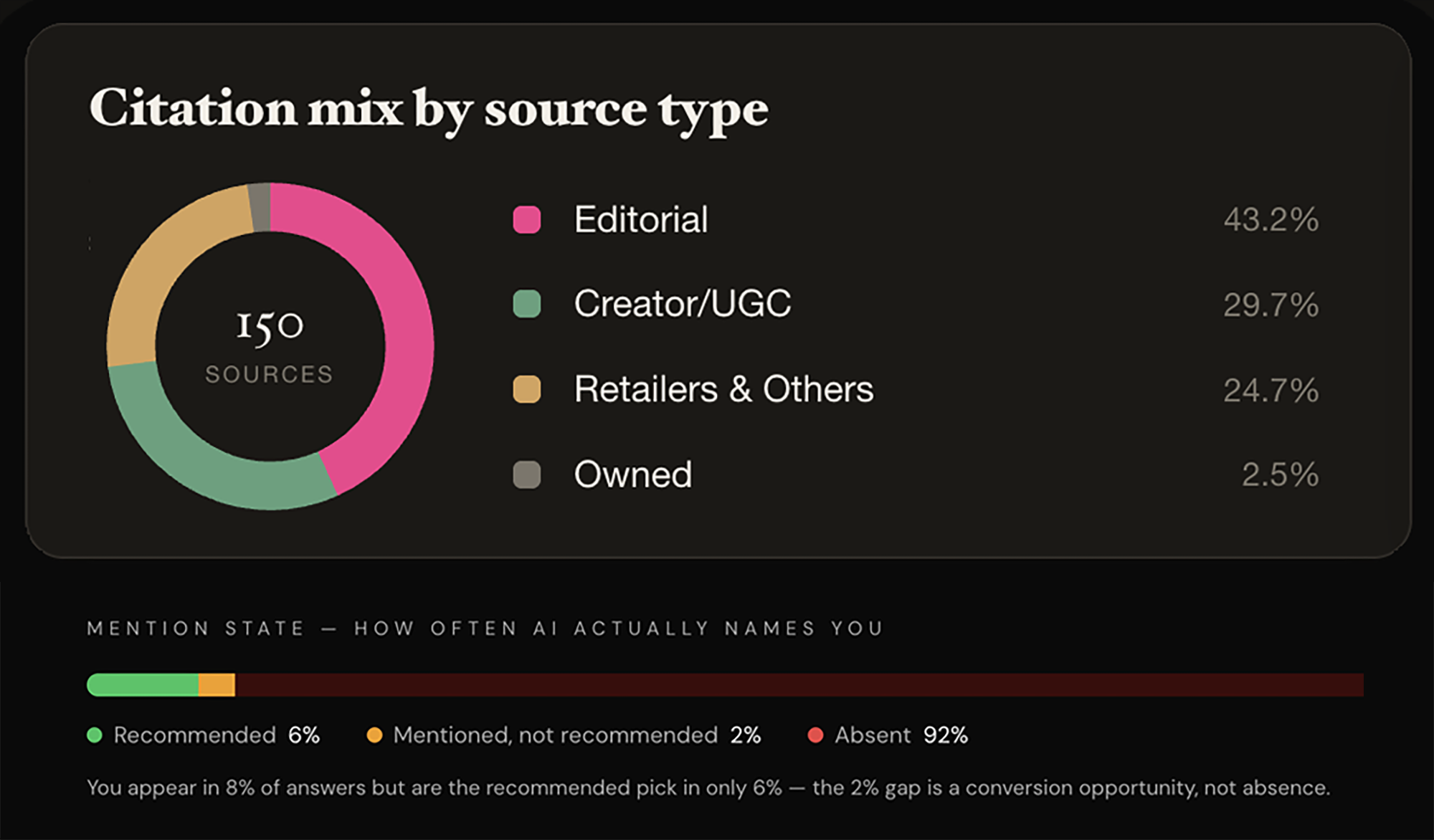
We measure how AI ranks your brand against competitors as Authority, and it’s often won with content you did not create. A study of U.S. beauty brands, for example, found that only 20% of LLM citations came from a brand’s website. The other 80% included retailers, news media, specialist blogs and other sources like Reddit, YouTube and comparison articles.
Amplify a conversation you did not start. Find threads where buyers are already discussing your products and add to them. Dove found an existing Reddit thread about its Intensive Repair hair mask and invited that community to test the product. As a measure of its transparency (which consumers and AI value), the brand committed to publishing the first 50 reviews, regardless of what they said. They then put the real comments on billboards in NYC’s Flatiron District. This strategic UGC generated over 100,000 impressions, 263 million views and drove triple-digit sales growth in the first month. That conversation still sits on Reddit, the most-cited source in ChatGPT’s beauty recommendations through the first half of 2026. Its share fell sharply in mid-August while Google’s AI Overviews remained steady. A clear reminder that no single platform serves as a silver bullet.
Cast the creators that AI already cites. To quickly identify the creators worth targeting for AI mentions, run your category’s questions through the engines, build a citation list, then work with the creators whose content appears consistently instead of choosing on reach or engagement alone. To rank in Google’s AI Overviews, focus on YouTube. It’s the most-cited domain for that engine, up 34% in the past six months alone. As one of the most established beauty creators, Hyram Yarbro is a classic example of content AI favors. His 4.4 million subscribers and 559 million views are built on ingredient breakdowns and “is-it-worth-it” verdicts, the exact formats AI seeks when shoppers ask about efficacy and budgets. A strong Wikipedia page adds credibility and boosts citations further. For your next creator brief, have them answer the specific questions buyers ask, in the language buyers use, then re-run the prompts in 30 days to see if the AI answer includes you and how you rank against your competitors.
Ensure clarity and consistency across retailer pages. When describing how your products compare, be as detailed and accurate as possible, especially on pages that are close to the ecommerce conversion point, like retailer sites. This is a key strategy for RoC, as they see a great deal of Gen AI traffic going through retailer PDP pages. Any inconsistencies between these pages and a brand's own pages weaken the integrity of the messaging, and AI models rely on those pages less often. Retailers are moving fast to ensure their own position in the process. Sephora launched inside ChatGPT, where it assists with “curated advice and recommendations.” While earlier plans also included allowing customers to check out directly on ChatGPT, the platform has since removed that option entirely. This space is evolving quickly and staying on top of what works and what doesn’t is an imperative every CMO needs to prioritize.
The AI Answers Are Always Being Rewritten
LLMs update their models often, and shifts in a competitor's strategy can replace your ranking. A constant focus is table stakes, and three questions drive the success of every brand vying for a spot on the shortlist.
Does AI describe your brand the way you intended? This is where a brand’s Fidelity score shines. The more accurately AI understands you, the clearer it communicates to the market. Tracking Fidelity over time and improving it with proven tactics ensures consistent performance.
Does AI include your brand or product when buyers ask? Having a strong Presence score improves a brand’s chance of being recommended in the answers. Knowing exactly what questions customers ask and using those same words on FAQ and related pages keeps the brand cited in the AI answers.
Does AI recommend you ahead of the alternatives? Having a high Authority score means your brand leads its category. This battle is waged in forums like Reddit, creator content on platforms like YouTube and retailer pages. While all are outside of a brand’s direct control, they can be influenced by proactive brands that understand the new rules of AI discovery.
Each of these measures catches what the others miss. A brand can be described accurately but still never surface. Another can show up in every answer but be presented incorrectly. A brand can manage both, then lose the recommendation to a competitor with a deeper editorial trail or recommendation from a better-cited creator.
Good or bad, none of this is static. For the long term, brands need an always-on understanding of how their brand and hero products are represented, and a scalable way to manage messaging across creators, retailers, and editorial. That is the exact gap Qulture built its AI visibility platform to close.
Branding has always been about getting people to remember a name. Now that includes teaching a machine to recommend it. Going forward, the brands that AI names will be the ones that clearly, accurately and consistently communicate to humans and machines alike. For brands not yet on the shortlist, the work is to find the misses and start shaping what the answers say.
Find out where your brand stands in the AI answers. Email us to schedule a call. We’ll walk you through your rankings and the gaps worth closing first.
FAQ
-
Legacy equity does not guarantee visibility. It took 14 searches across AI platforms to surface Borghese's hero mud treatment, Fango, from a skincare house founded in 1957. Nearly 70% of luxury prompts do not name a brand at all. To make things more challenging, 90% of the links those answers did cite pointed somewhere other than the brand’s own site.
-
No. When Georgetown and the University of Virginia ran identical prompts across ChatGPT, Claude, and Gemini in 15 retail categories, more than 700 brands appeared, yet some of the most heavily advertised names never did (HBR, 2026). AI builds its answers by consensus, drawing on reviews, Reddit threads, creator content, retailer listings, and editorial, none of which a brand controls directly. Visibility follows what people say about you across those sources.
-
Start with your own inputs. McKinsey calls conflicting brand messaging "signal dissonance," and the greater it is, the less likely a model is to surface you or describe you correctly (State of Consumer, 2026). Resolve the claims that disagree across your store, retailer listings, and old press, the way Borghese did with "Project PDP," rebuilding its product pages as a factual source for AI. Clean first-party data gives models something reliable to cite.
-
Answer the exact questions buyers ask, in their words. A broad category question and a specific problem question return different shortlists, and only 11% of brands appear in both (Georgetown and University of Virginia, 2026). Publish FAQs on your product pages that match how people actually describe their needs. RoC Skincare wrote more than 400 question-and-answer sets into its pages to do exactly this, making its content easier for AI to cite.
-
Because AI recommends products first, and the brand name comes along with them. In the Georgetown and University of Virginia study, well-known brands surfaced once specific models were named: Toyota in questions about the RAV4 and Highlander, Coca-Cola and Pepsi in their zero-sugar versions (HBR, 2026). One hero product can carry a brand into the answer, so each needs its treatable problem, active ingredients, size, price, and ideal buyer spelled out for AI to compare.
-
Mostly from sources you do not own. In a study of US beauty brands, only 20% of AI citations came from the brand's own website; the other 80% were retailers, news media, specialist blogs, Reddit, YouTube, and comparison articles (HBR, 2026). The answer is assembled from the wider conversation about your products, so that conversation is where the work is, rather than the homepage.
-
By shaping the conversations AI already reads. Dove joined an existing Reddit thread about its Intensive Repair hair mask, committed to publishing the first 50 reviews whatever they said, and turned the comments into billboards, generating 263 million views and triple-digit sales growth in the first month (Glossy, 2026). Reddit is the source ChatGPT cites most for beauty, and the creators AI already quotes, like YouTube's ingredient reviewers, are the ones worth casting next.