
Mapping the Frontier of AI Influence - Part 2
Part two of Mapping the Frontier of AI Influence, a three-part series on AI visibility for beauty and luxury brands.
AI Answers Are the New Brand Scoreboard
Imagine an ad for a Hèrmes scarf. Dominated by white space, it reads as elevated, reflecting luxury, restraint, and status all without saying a word. Show that same ad to an AI model and it sees almost nothing, literally. According to research conducted by INSEAD, AI is mostly blind to the nuances that luxury brands have spent decades perfecting. Even more concerning, sometimes it sees simplicity as cheapness. For as smart as AI is, it can’t seem to read between the lines.
More than a billion people use AI monthly, with shopping as one of the fastest growing categories. It answers questions with confidence using a brand description you never wrote, created from sources you’ve likely never seen. After years of marketers building a brand world, AI is deciding who sees it and how it gets described and ranked among competitors. The AI answers are the new search results, and brands that don’t appear don’t land the sale.
At Qulture, we’ve developed an AI visibility framework comprised of Fidelity, Presence, and Authority that powers our proprietary insight platform. Each one is a lever, and each one shapes what the AI answers say about your brand. And those answers are increasingly driving conversions. Shoppers arriving from an AI source are 15% more engaged than shoppers from any other channel, and they stay longer and browse deeper once they land.
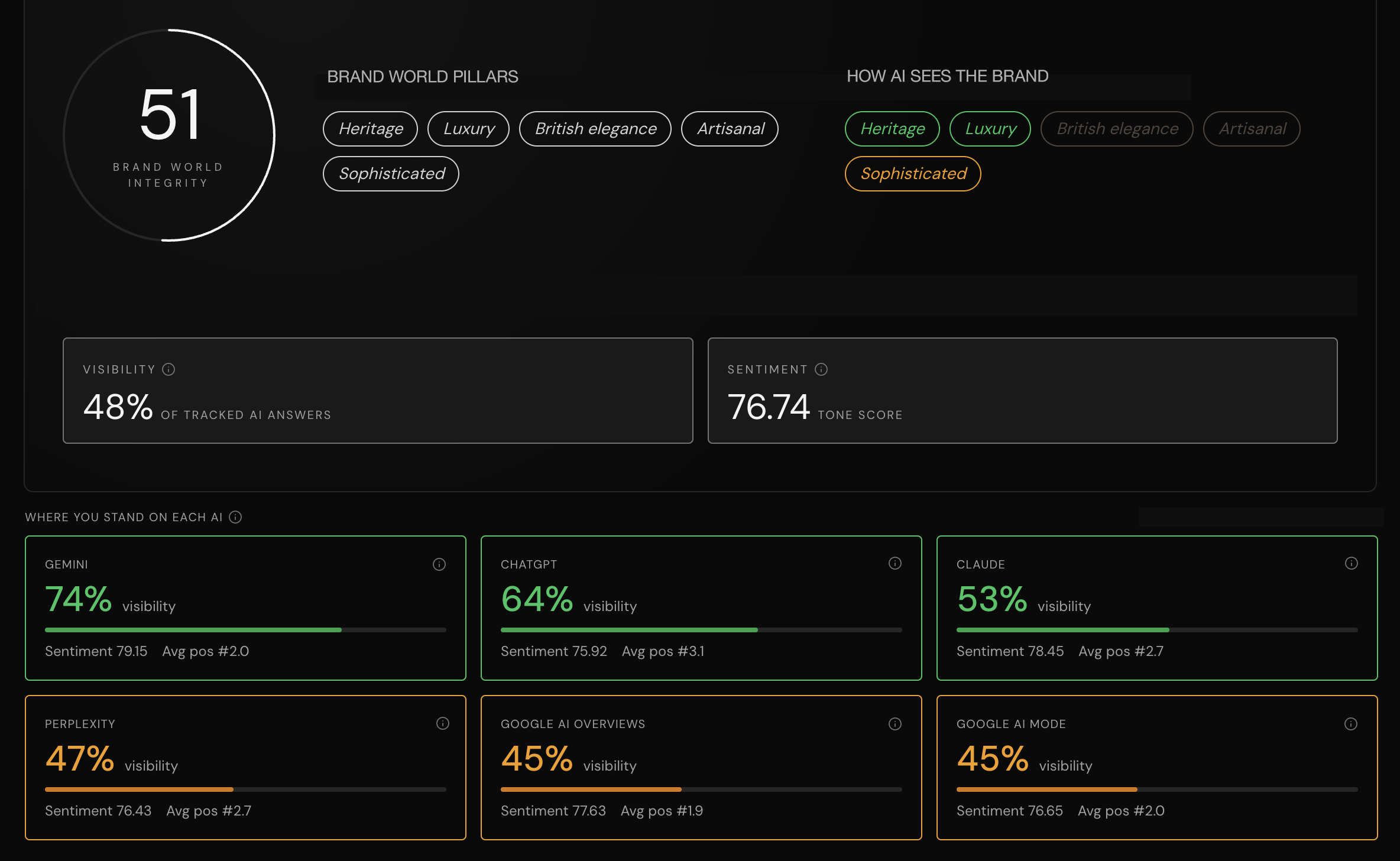
Fidelity: How the AI Answer Describe Your Brand World
Fidelity is all about the difference between being named and being understood. It’s a measure of your brand world the way you built it versus the version the machine repeats back. The sooner those narratives are aligned, the sooner brands can start to course correct.
As many CMOs are now seeing, AI often gets it wrong. For brands appearing on more than one platform, 55% were described quite differently across them. Across 5,400 evaluations, that same INSEAD study shows that the luxury hierarchy fails to register with AI at all. In one instance it rated a Ferrari as no more luxurious than a BMW. It also misread a strength as a weakness for ski brand Atomic. Here, AI interpreted the ski’s rigidity (a quality expert skiers pay a premium for) as a defect and steered buyers elsewhere.
Old content can come back to bite brands as well. Outdated reviews and blog posts can stay indexed long after a house has moved on. The only solution is to identify what AI is reading and correct it. That can mean requesting updates on editorial listicles that still include a retired product, updating incorrect retailer pages, and seeing what content on your owned channels is no longer aligned with your current positioning.
Being visible to AI engines is important for awareness, but appearing correctly is critical to conversions.
Presence: Showing Up Where It Counts
Think of Presence as a measure of how much your brand shows up in AI answers. La Roche-Posay is one of the leaders here, appearing in 81% of facial skincare queries on ChatGPT in early 2026, the highest rate for any one brand tracked on the eMarketer AI Visibility Index.
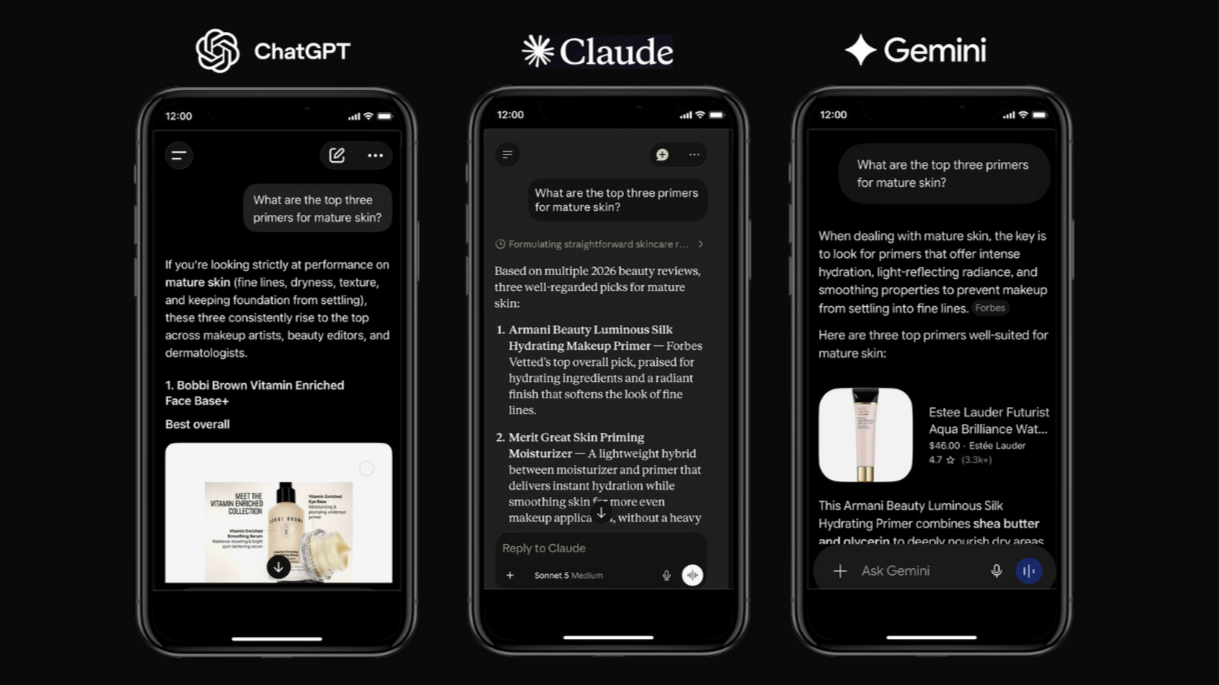
It’s important to note, however, size is not a guarantee of visibility. When asked for running shoe recommendations, ChatGPT, Claude, and Gemini all had surprising results. Nike barely appeared. The largest athletic brand in the world showed up far less reliably than competitors a fraction of its size. Surfacing consistently can also be challenging, as only 8.4% of brands showed across all three models. Most were visible on one but absent from the others.
Brands can easily miss this when they only see a visibility average across LLMs. A blended score hides what needs to be fixed, and it’s constantly changing. This means tracking needs to be incorporated into the modern marketing workflow for a true picture of performance.
Authority: Getting Listed Is Table Stakes. Getting Chosen Is the Game.
Authority is a measure of how AI recommends you relative to the competition at the moment shoppers decide what to buy. The challenge is that you can’t buy your way in. Most of what AI cites is earned. This includes editorial coverage, roundups, retailer pages, reviews, creator videos, particularly those on YouTube.
A recent study found that across 27 million AI answers, YouTube creator content appears more than one in four times. Further, niche creators outrank brand channels and even celebrity names inside that content. For ChatGPT specifically, Reddit is the most-cited source for beauty and fragrance recommendations, beating out every magazine and retailer, based on Novi’s analysis of 10.7 million citations from the platform.
Counterintuitively, AI recommends Brooks over Nike for the same reason: earned specificity. For more than 20 years, the brand built an ecosystem of coaches, clinicians, and specialty retailers who could all say precisely which shoe solved a specific problem for a particular kind of runner. That specificity led to high visibility, which drove recommendations based on data points and expert opinions.
You Can’t Fix What You Can’t See
Nike didn’t choose to show up less; the models chose for it. Atomic was unaware its best feature was being worded as a weakness. To make matters worse, AI answers are non-deterministic, meaning they are always changing. Constant tracking, analysis, optimization and verification are needed to earn a consistent spot on the AI shortlist.
If SEO rewards rank and social media rewards engagement, AI answers reward being understood as a clear solution to a user’s question. Forward-thinking brands already know this and are starting to shape their narrative across the LLMs. The rest are being described to millions by a machine.
Read part three of Mapping the Frontier of AI Influence, a three-part series on AI visibility for beauty and luxury brands.
Find out where your brand stands in the AI answers. Email us to schedule a call. We’ll walk you through your rankings and the gaps worth closing first.
FAQ
-
Qulture measures AI visibility through three: Fidelity, Presence, and Authority. Fidelity is how accurately AI describes your brand world. Presence is how often AI includes your brand in the answer. Authority is how AI ranks you against competitors when a shopper is ready to buy. Together they make up the AI Visibility Framework, and each one shapes what the AI answer says about you.
-
Fidelity is the difference between being named and being understood. It measures your brand world the way you built it against the version the machine repeats back. It matters because AI often veers off: among brands appearing on more than one platform, 55% were described differently from one model to the next (HBR, 2026), a premium innovator on one system and a budget alternative on the next.
-
Yes, and more often than you would expect. A response can be fluent, detailed, and completely wrong, which is Presence without Fidelity. Across 5,400 evaluations, INSEAD found the luxury hierarchy does not register with AI, which rated a Ferrari no more luxurious than a BMW (HBR, 2026). The ski brand Atomic watched AI read its signature rigidity, the exact quality expert skiers pay for, as a defect.
-
Presence varies by model, and a single blended score hides it. Only 8.4% of brands appear consistently across ChatGPT, Claude, and Gemini (Georgetown and University of Virginia, 2026). Nike, the largest athletic brand on earth, showed up less reliably than rivals a fraction of its size. A brand can own ChatGPT, never appear on Claude, and average out to something unremarkable while sharper rivals pull ahead on each model.
-
It looks like near-total Presence on the questions that matter. ChatGPT named La Roche-Posay in 81% of facial skincare queries in early 2026, the highest rate for any brand in any category the eMarketer index tracks. When a shopper asks what to buy, one brand is the answer, and every rival competes for what is left.
-
Authority is how AI ranks you against competitors at the moment a shopper decides, and it has to be earned. A brand's own site accounts for only 5 to 10% of the sources AI pulls from (McKinsey, 2025). The rest is editorial, retailer pages, reviews, and creator content. Across 27 million AI answers, Jellyfish found YouTube creator content appears in more than one in four, with niche creators outranking brand channels (Adweek, 2026).
-
Because the answer rewrites itself as models retrain and sources shift weekly, so a brand strong in spring can be invisible by autumn. Earned authority is the counterweight: Brooks built its ecosystem of coaches, clinicians, and specialty retailers over twenty years, and that validation compounds where ad spend cannot (HBR, 2026). Holding a spot in the answer takes constant tracking, analysis, and verification.