
Building an AI-first Creator Playbook | Part 1
Qulture's six-part series on the new rules of creator strategy as shoppers turn to AI.
Stars, Experts, and Friends
Why your best-paid creator might be invisible to AI
Andrew Polo is a fashion creator. He also has eczema, and he talked about it in an interview with the health publisher HealthCentral. Then the machines started paying attention. ChatGPT and Claude began surfacing him when people asked for eczema creators, and his brand inquiries rose 50%. His TikTok following grew 1.5% over the same stretch. Skincare brands, including Hypothesis and MAGS Skin, came calling. AI, the newest gatekeeper in shopping, had decided he knew what he was talking about.
Expect more stories like his. US brands will spend $44 billion on creators this year, IAB projects, and AI is changing which ones are worth the money. About 65% of Gen Z and millennial AI shoppers said they prefer AI recommendations that include creator perspectives. The biggest names on a roster can be the hardest for AI to find.
AI reads the way a researcher does. In a Gumshoe study of 1.1 million YouTube citations, the videos Google's AI quoted were the ones most relevant to the question. Follower count, the number the creator business has long priced itself on, turns out to be a weak predictor of landing in the AI answer.
When Qulture mapped how creators move a shopper from first scroll to checkout, the same three patterns kept appearing. We call them Stars, Experts, and Friends. Each does its own job for the business. Brands need all three, and AI weighs each one differently. That creates a pricing gap. The creator you pay the most may be the one AI can barely see, and the one it quotes most may cost the least.
Stars win the feed
In March, Mikayla Nogueira went live on TikTok Shop for a perfume brand called Snif. More than a million people watched.
Nogueira is a Star. Stars give a brand scale, turning a launch into an event within hours.
Fame in the feed doesn't always travel to AI. In BrightEdge's tracking, TikTok made up only 0.1% of the sources cited in Google's AI Overviews. Big-budget fame has the same problem. "I spent a fortune on a Super Bowl commercial and an LLM doesn't give a damn about it," Rocket Companies CMO Jonathan Mildenhall told Fast Company in August.
A Star's value to AI runs through the press. In an Ahrefs study of 75,000 brands, web mentions were the factor most closely tied to appearing in Google's AI Overviews. A Star turns a launch into a story, and the press that follows gives AI more mentions of the brand to find.
Experts win the AI answer
Lisa J, a YouTube creator who founded the brush brand BK Beauty, posted a long, chaptered video for the Nordstrom Anniversary Sale. It drew half the views of her best videos and more than double the sales.
Lisa J is an Expert. Experts earn credibility by answering the specific questions shoppers ask before buying.
That depth is what AI reads. In August, YouTube was the most-cited platform in AI answers, and nearly all of those citations went to long-form video. Gumshoe found the videos Google's AI quoted ran a median of 9.4 minutes, against 6.2 for those it skipped.
Strategist Eugene Healey calls influence built only on social platforms "synthetic" until press and other real-world proof back it up. That outside proof is also what AI looks for. Long-form video is the other road in, and Experts can travel both
Friends win the purchase
Gini Vasquez has 153,000 followers, a modest number by influencer standards. According to Glossy, she has sold more than $10 million on TikTok Shop over two years.
Vasquez is a Friend. Friends are how a brand closes the sale. In IAB's September study, shoppers ranked everyday consumers the most trusted type of creator, at 52%.
Where a Friend posts matters for AI. "What people say in the comments on YouTube, Reddit and LinkedIn, the LLMs really care about," Mildenhall says. In a GrowByData count of US retail searches from April to June, user-generated platforms like YouTube, Reddit, and Instagram supplied 27% of the citations in Google's AI Overviews. A Friend can drive sales on TikTok Shop and still be invisible to AI. The recommendation also needs to live on the platforms answer engines cite.
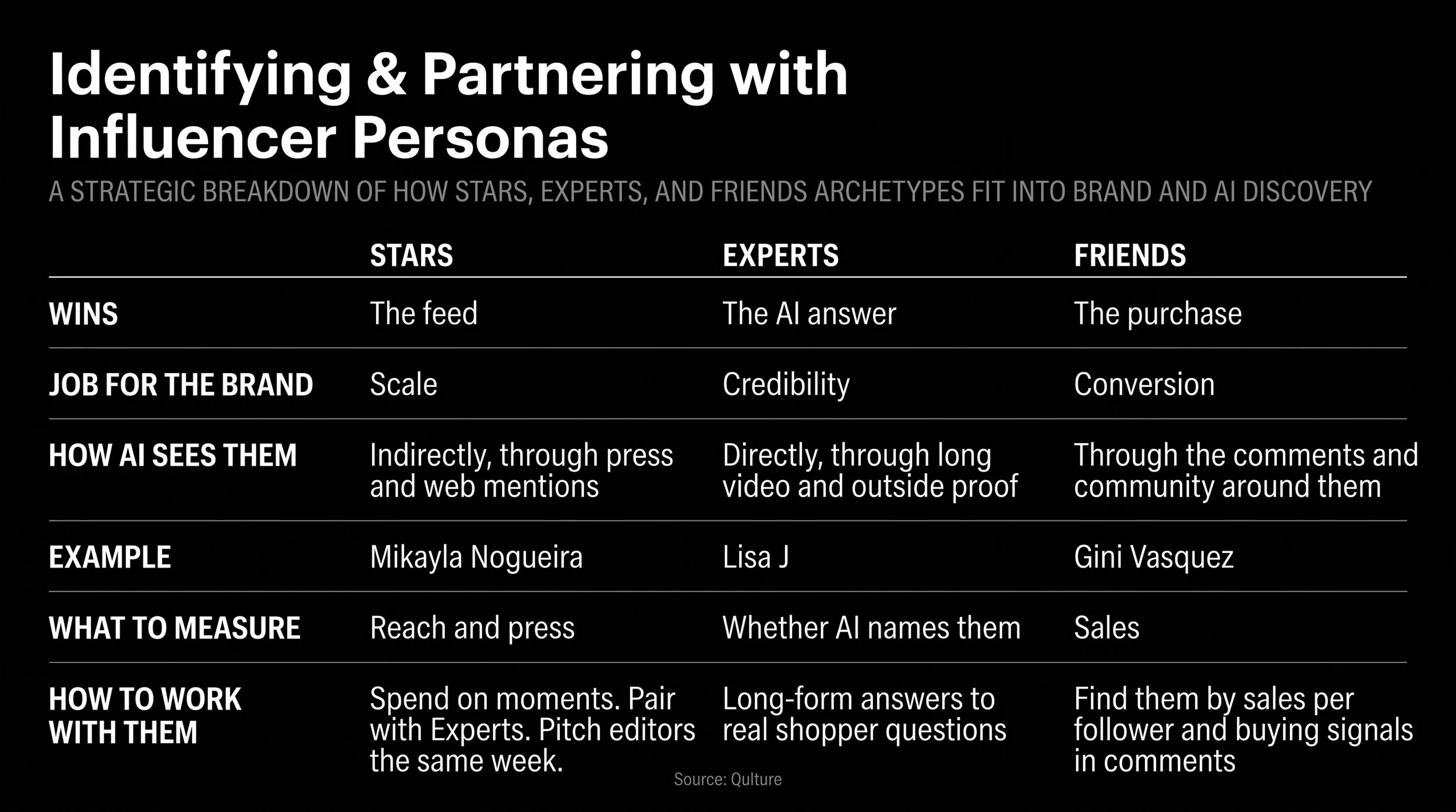
Qulture’s creator framework for AI search, built to share with your team: what each type wins, how AI sees it, and how to work with each one.
The market hasn't priced this in yet
In September, Digiday found rate cards hadn't moved to reflect who AI cites, and the agency Tinuiti expects no change for six to 12 months.
The math was off before AI arrived. Research shared in Harvard Business Review by Bocconi University's Maximilian Beichert tracked close to 2 million purchases. Influencers with fewer than 10,000 followers turned about $50 of free product into more than $1,000 in sales, a 20-to-1 return. Those with more than 100,000 followers cost well over $1,000 and returned only $6,000, less than 6 to 1. AI now gives the smaller, sharper creator a second edge.
Put each creator to work
Knix, the leakproof underwear brand, shows a full lineup at work. In 20 buying-stage searches across ChatGPT and Google's AI Mode, analyzed by Search Engine Land in August, Knix came up 29 times. H&M, Uniqlo, and Victoria's Secret came up twice, combined. Its Star, Ashley Graham, earned press. Editors at InStyle and Glamour played the Expert, giving AI something to cite. Its ambassadors act as Friends, posting between launches. Small sample, clear pattern.
Knix gave each creator one job. That is the heart of Qulture’s approach. First, decide what you need from a creator: the crowd, the proof, or the sale. Then brief each one so their work lands where AI looks: in the press, in long-form video, or in the comments.
Stars: Spend them on moments, and pair each one with an Expert, such as a chemist or perfumer who can explain why the product works. Brief them to say the product's full name on camera and in the caption. Then pitch the moment to editors that same week, since the coverage is what AI picks up.
Experts: Treat their content as infrastructure. Long-form YouTube, 10 minutes or more, with chapters and detailed descriptions. Reviews and earned press. Brief them on the questions shoppers type. Give them time with your formulators and ingredient data, so their answers are specific enough to quote. Fund fewer, longer videos over a stream of short ones.
Friends: Find them in your sales data. Rank creators by sales per follower, using the discount codes or affiliate links you provide. Those small accounts at the top are your Friends. You can also put AI to work on the comments. Pull them from your social listening tool, then have a model rank creators by how often their comments show buying signals: link requests, "just ordered," and "where can I buy this?" This spots them before a sales report does.
Your team already audits its creators. Add one step: sort them into Stars, Experts, and Friends, then compare what each group costs with what it returns. For Stars, that's reach and press. For Friends, it's sales. For Experts, it's whether AI names them when shoppers ask. Back the group whose return has outgrown its price. The evidence says to start with Experts.
Andrew Polo's following grew 1.5%. His inbox grew 50%. Somewhere on your roster is someone just like him. Find them before the rate card does.
What's next: AI visibility is the first of five shifts we’re defining in our series: Building an AI-first creator playbook. Coming up next: Creativity & Storytelling, Always-On Momentum, Localization & Subcultures, Measurement, and The AI-First Creator Playbook.
To find out which creators AI cites in your category and what it means for your 2027 creator playbook, reach out for a complimentary 30-minute data and strategy snapshot based on more than 100 AI answers.